
Introduction to Agricultural Pumps and Electric Motors
Learning Objectives
By the end of this lesson, learners will be able to:
- Understand the role of pumps and electric motors in agriculture.
- Identify common uses of pump-motor systems on farms.
- Recognize the benefits of mechanized water and energy solutions.
- Distinguish between manual, fuel-powered, and electric systems.
- Appreciate the importance of selecting the correct equipment for specific tasks.
Detailed Lesson Content
1.1 The Need for Mechanization in Agriculture
Modern farms require reliable water supply and energy to:
- Irrigate crops
- Operate machinery
- Supply water to livestock
- Process farm products (e.g., grinding, milling, mixing)
This is where pumps and electric motors play a crucial role by improving efficiency, reducing labour, and enhancing productivity.
1.2 What Is an Agricultural Pump?
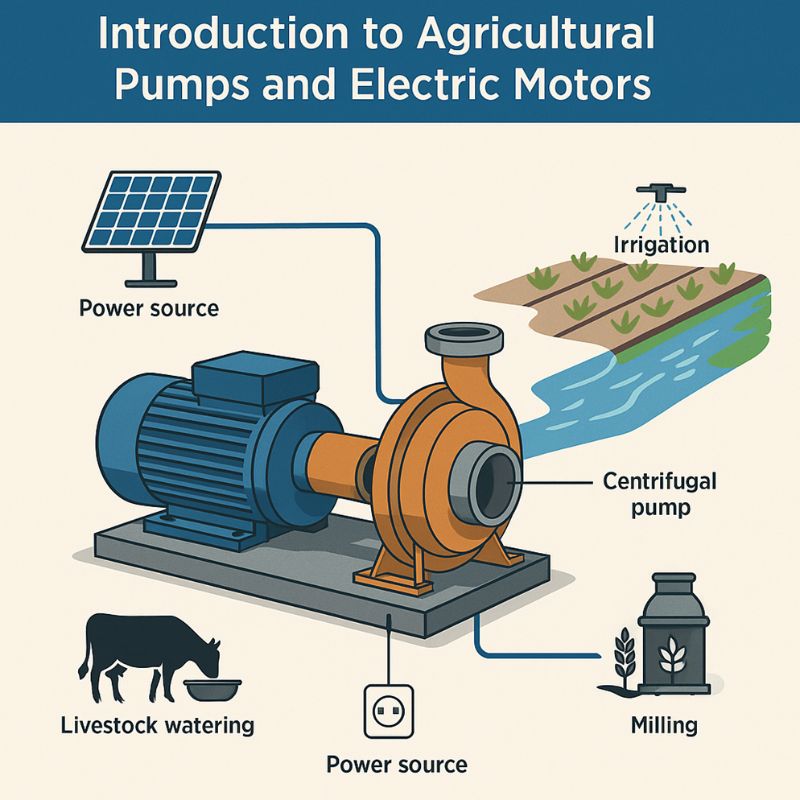
A pump is a device that moves liquids (usually water) from one place to another. On farms, pumps are used for:
- Irrigation (flood, sprinkler, or drip systems)
- Filling or emptying tanks, reservoirs, or dams
- Dewatering flooded fields
- Distributing water to livestock
Pumps may be:
- Manually operated (hand or treadle pumps)
- Fuel-powered (diesel/petrol engine pumps)
- Electrically powered (connected to mains or solar)
1.3 What Is an Electric Motor?
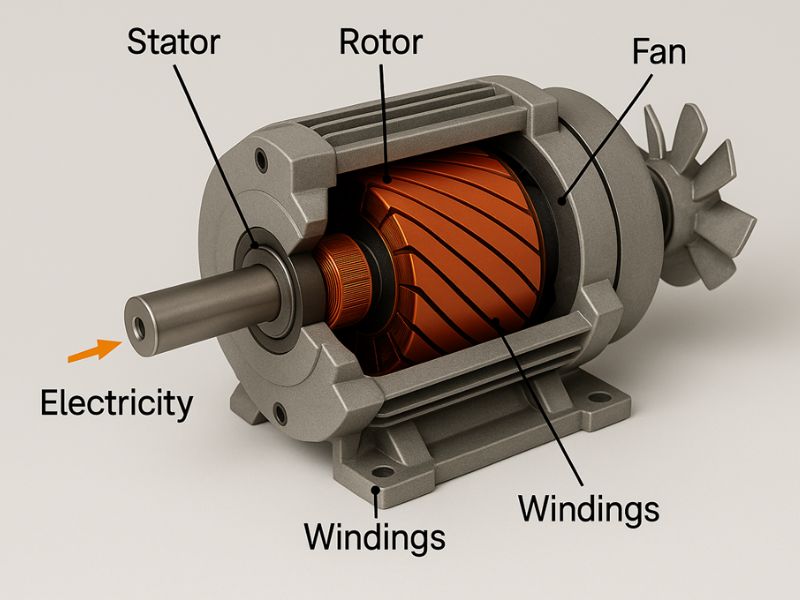
An electric motor converts electrical energy into mechanical motion. It is used to power various farm equipment, including:
- Pumps
- Grain crushers or mills
- Conveyors
- Fans and blowers
- Processing machines (shellers, grinders, etc.)
Most motors used in agriculture are either:
- Single-phase motors – for light-duty work and smaller farms
- Three-phase motors – for high-power tasks and larger operations
1.4 How Pumps and Motors Work Together
On most farms, pumps are paired with motors to automate water movement. The motor provides the mechanical energy that drives the impeller inside the pump, causing water to flow through pipes or hoses.
A typical system includes:
- Electric motor
- Coupling or shaft
- Pump (centrifugal, submersible, etc.)
- Power supply (AC grid, generator, or solar)
- Pipes and valves
Example: A borehole pump driven by a submersible motor extracts water for drip irrigation.
1.5 Benefits of Using Electric Motors and Pumps in Agriculture
| Benefit | How It Helps |
| Labour-saving | Reduces need for manual hauling or hand-pumping |
| Consistent performance | Reliable water supply for irrigation or livestock |
| Time efficiency | Faster pumping means less waiting time |
| Precision and control | Easy to automate with timers and controllers |
| Clean and renewable | Electric and solar motors reduce fuel pollution |
Key Terms
| Term | Definition |
| Pump | A device that moves liquids through force or suction |
| Electric Motor | A machine that turns electrical energy into movement |
| Irrigation | Supplying water to crops in controlled amounts |
| Submersible Pump | A pump designed to operate underwater, often in boreholes |
| Coupling | A mechanical connector joining a motor to a pump shaft |
Summary
Pumps and electric motors are foundational to modern farming. They automate essential processes like irrigation, livestock watering, and post-harvest processing. Understanding how these systems work helps farmers improve efficiency, save energy, and select appropriate tools for their operations.