Types of Drones Used in Agriculture
Learning Objectives
By the end of this lesson, learners will be able to:
- Identify the main types of drones used in agricultural operations.
- Understand the features, benefits, and limitations of multirotor, fixed-wing, and hybrid drones.
- Compare drone types for specific agricultural applications.
- Choose the right drone type for different farm sizes and needs.
2.1 Why Different Drones for Different Tasks?
Not all drones are the same. In agriculture, the type of drone you use depends on:
- The size of the land
- The task (monitoring, spraying, mapping, etc.)
- Flight time and range
- Payload capacity
- Budget and operator skill level
Understanding the differences between drone types helps farmers and Agri-professionals make the right investment.
2.2 Multirotor Drones
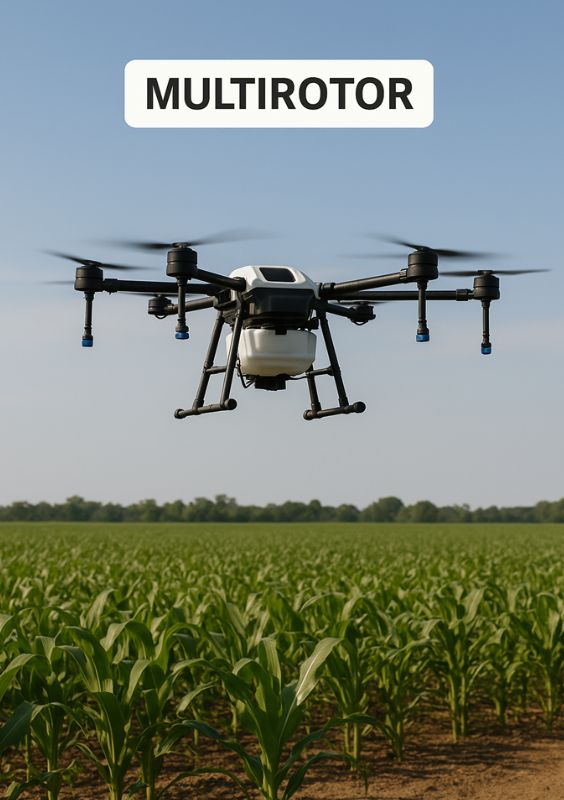
Description:
These are the most common agricultural drones. They have multiple rotors (typically 4, 6, or 8) and are capable of vertical take-off and landing (VTOL).
Key Features:
- Excellent for hovering and close-up inspections
- Easy to control, ideal for beginners
- Shorter flight time (15–30 minutes)
- Limited coverage per flight (2–20 hectares)
- Lower wind resistance
Best Uses:
- Aerial spraying over small plots
- Crop health monitoring
- Spot-checking problem areas
Example: A farmer uses a multirotor drone to spray pesticide on a 3-hectare tomato field in Ghana.
2.3 Fixed-Wing Drones
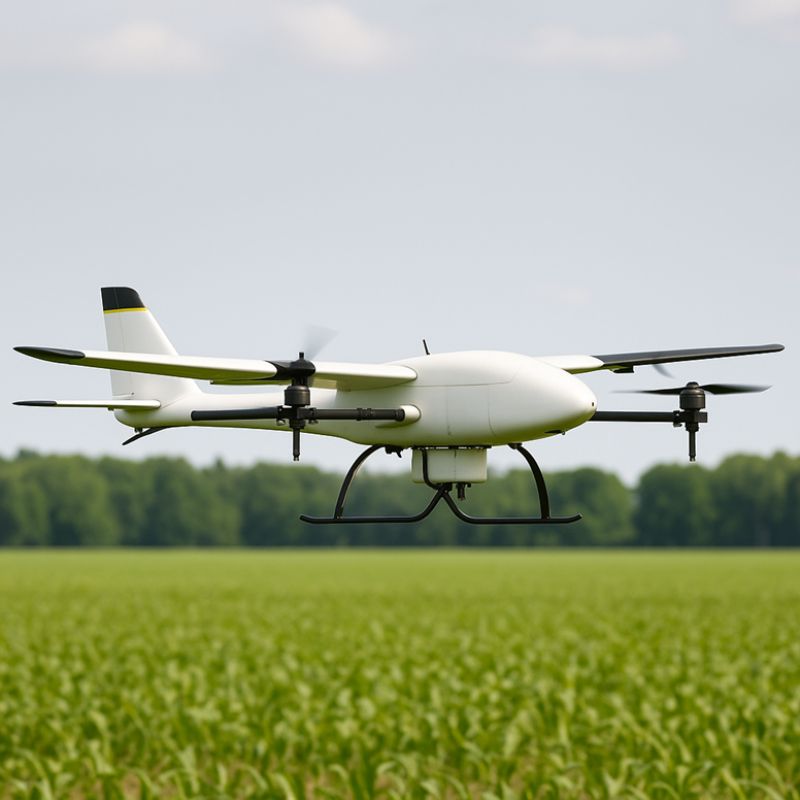
Description:
These drones have wings like an airplane and require forward movement to generate lift.
Key Features:
- Long flight time (up to 60–90 minutes)
- Can cover larger areas (50–100+ hectares in one flight)
- Cannot hover or take off vertically (needs a runway or launcher)
- Requires more training and skill to operate
- Greater wind tolerance
Best Uses:
- Aerial mapping and large-scale survey
- NDVI (plant health) imaging
- Monitoring large estates or commercial farms
Example: A tea plantation in Kenya uses a fixed-wing drone to generate topographical maps for water drainage planning.
2.4 Hybrid Drones.
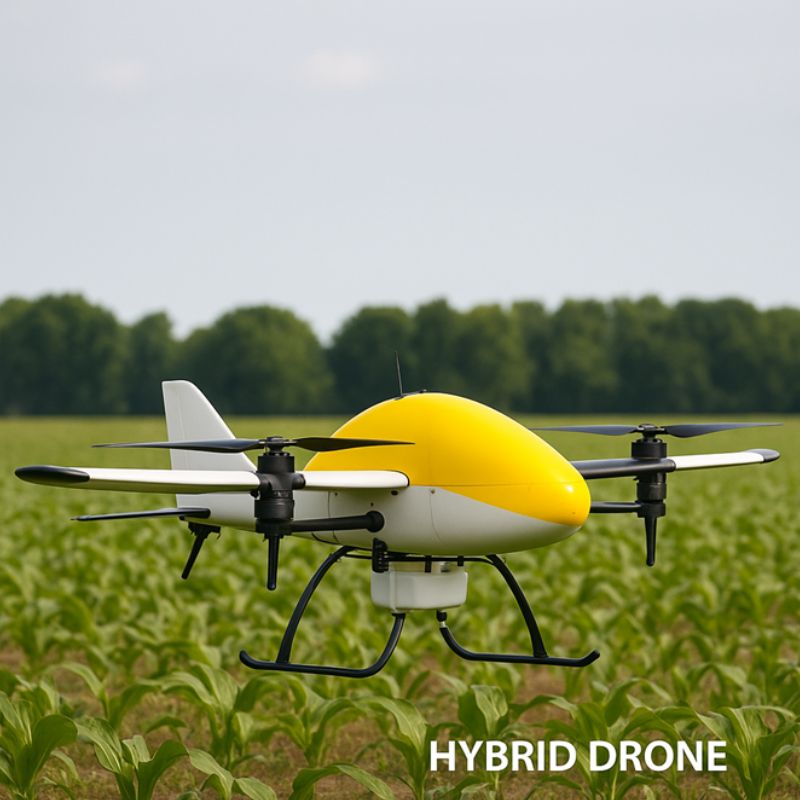
Description:
These combine features of multirotor and fixed-wing drones — they can take off vertically like a multirotor and fly long distances like a fixed-wing drone.
Key Features:
- More complex and expensive
- Offer balance between endurance and manoeuvrability
- Useful for medium-to-large farms
- Becoming popular in commercial Agri-tech sectors
Best Uses:
- Tasks that require both hovering (e.g., spraying) and wide coverage (e.g., mapping)
- Multi-field farms or mixed crop systems
2.5 Comparing Drone Types
| Feature | Multirotor | Fixed-Wing | Hybrid |
| Flight Time | 15–30 min | 60–90 min | 45–75 min |
| Area Coverage | Small plots | Large farms | Medium to large |
| Launch Requirement | VTOL | Runway/launcher | VTOL |
| Payload Capacity | Low to moderate | Moderate | Moderate |
| Ease of Use | Very easy | Moderate to hard | Moderate |
| Cost | Low to medium | Medium to high | High |
Key Terms
| Term | Definition |
| Multirotor Drone | A drone with multiple vertical propellers; hovers and lands vertically. |
| Fixed-Wing Drone | A drone with fixed wings that glides through air like an aircraft. |
| Hybrid Drone | A drone that combines vertical take-off with long-range flight. |
| VTOL | Vertical Take-Off and Landing – the ability to lift off and land without a runway. |
| Payload | The weight of equipment (e.g., camera, sprayer) a drone can carry. |
Summary
Different drone types serve different agricultural needs. Multirotor drones are great for spraying and scouting small areas, fixed-wing drones excel in mapping and monitoring large farms, and hybrid drones offer flexibility with endurance. Selecting the right drone is based on farm size, required task, available budget, and the operator’s experience level.