
Supply and Demand
THE FARM AS A BUSINESS
Before considering the business side of farming, let us take a brief look at the food position in the world today. Estimates from the Food and Agriculture Organisation of the United Nations indicate that, in the year 2012, 870 million people were chronically undernourished. The majority of these people live in developing countries, where approximately 15% of the population are estimated to be hungry. Although, since the 1990’s, there have been significant reductions globally in the number of undernourished people in the world, Africa and especially Sub-Saharan Africa has shown an increase in the share from 17% to 27% of the world’s undernourished people. This means that the amount of undernourished people in Sub-Saharan Africa is a greater contributor to the world figure. Sub-Saharan Africa rates second after Southern Asia, with the greatest share of the world’s undernourished people. The rate of the world’s population in an undernourished state is generally decreasing, but there are still significant numbers of hungry people in the world.
Agriculture and farming as a business will always be the foundation for any economy, for the simple reason that people need food to be active participants in the economy. Incomes between 1990 and 2010 have increased 2% per annum, resulting in substantial increases in demand for dietary energy. Adequate food intake is defined by the United Nations as being about 3 000 calories per day for a man, and 2 200 for a woman. Therefore, while undernourishment decreases, but is still prevalent in Sub-Saharan Africa, globally, incomes are increasing, creating an even greater demand for food production. This leaves farmers in a very strong position to become the most important people in the economy as they have to produce enough to feed the global population which continues to grow and change.
Modern agriculture is a dynamic industry which is affected in various ways by a number of different issues like climate, technology, marketing and government policies. Today’s farmer needs to be aware not only of his local situation, which affects his immediate production, but also needs to keep in touch with broader issues which all affect his business due to globalisation. South Africa and the entire region of Southern Africa is part of a global village and farmers are not only affected by the local market but also by the global market.
Four issues presented below demonstrate the growing necessity for highly productive African farmers to take the lead, not only farming for Africa, but for the world.
THE WORLD POPULATION GROWTH
The population of the world is increasing and all estimates at present are that the total population will reach 8 billion people by the year 2025, and more than 9 billion by 2050. The figure below shows the world population growth and the expected increase, and Table 1 gives an estimate of the situation in the eleven most highly populated countries in the world at present. What is interesting to note is that most of the future population growth is to occur in less developed countries and the developed country’s populations have stabilised. The Table 1 shows the most populous countries in 2012 which only features one African country, Nigeria. But it is expected that in 2050 three African countries will be represented amongst the most populous countries, namely Nigeria, Democratic Republic of Congo and Ethiopia.
Figure 1: World Population Prospect–Medium Variant
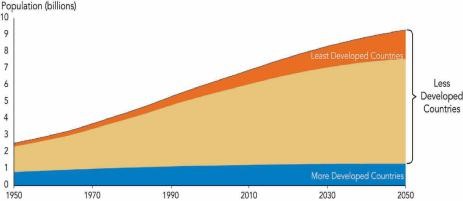
Source: Population Reference Bureau (2012)
Table 1: Most Populous Countries 2012 and 2050
| 2012 | 2050 | |||||||||||
| Country | Population (millions) | Country | Population | |||||||||
| (millions) | ||||||||||||
| China | 1,350 | India | 1,691 | |||||||||
| India | 1,250 | China | 1,311 | |||||||||
| United States | 314 | United States | 423 | |||||||||
| Indonesia | 241 | Nigeria | 402 | |||||||||
| Brazil | 194 | Pakistan | 314 | |||||||||
| Pakistan | 180 | Indonesia | 309 | |||||||||
| Nigeria | 170 | Bangladesh | 226 | |||||||||
| Bangladesh | 153 | Brazil | 213 | |||||||||
| Russia | 143 | Congo, Dem. Rep. | 194 | |||||||||
| Japan | 128 | Ethiopia | 166 |
Source: Population Reference Bureau (2012)
CHANGES IN FOOD CONSUMPTION PATTERNS
In all countries, an increase in urbanisation, wealth and the standard of living leads to an increase in demand for animal protein – meat rather than cereals such as maize, wheat and sorghum. The pattern of grain consumption varies greatly between rich and poor countries. Furthermore, the production of meat from cereals is an inefficient process.
- Milk and Eggs – 25%
- Broilers – 23%
- Pigs – 14%
- Beef – 4%
- Sheep – 4%
This means that for every 100 kg of cereal fed to cattle or sheep, only 4 kgs of meat is produced. Milking cows and laying hens are more efficient converters of cereal to milk or eggs, but even then three quarters of the cereal fed to the animals is used for other body functions.
However the demand for animal protein has increased all over the world, due to rising incomes and standards of living. Greater amounts of cereal grains are being produced for animal feed than ever before.
The FAO estimate as shown in the graph below, that global meat production will rise from 233 million tonnes to 300 million tonnes in the year 2020. It is also estimated that egg production will increase by 30%. This is indicative of the growing population and rising incomes especially in emerging economies like China, India and Brazil. Meat consumption per capita in developing countries over two decades, 1970 to the mid-1990s, went from 11 to 23 kilograms. This is a well-known trend throughout the developing world; as incomes rise so the diets change and people consume more meat. This ensures that more grains and legumes like soyabeans are produced for animal feed. The graph below indicates the historical and predicted trend in world meat production in developed and developing countries. The upward growth especially due to developing countries is quite astounding.
Figure 2: Total Historical and Estimated Future Global Meat Production
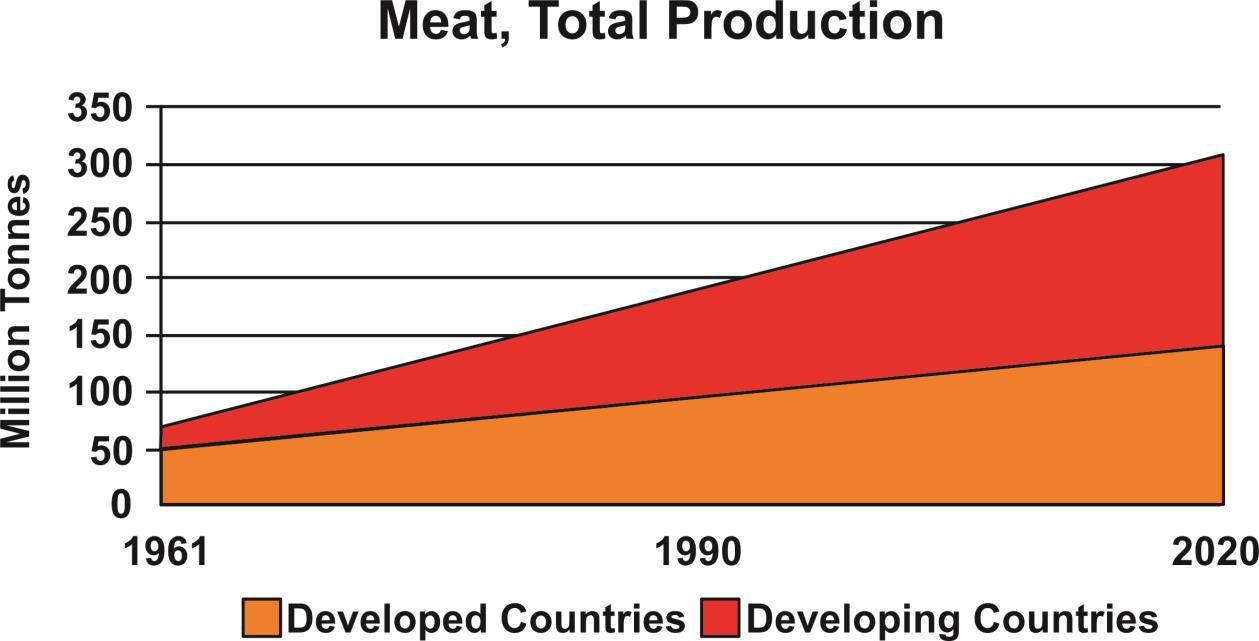
Source: FAO (2002)
Another product which is being increasingly produced from cereals and other crops like sugar cane and soyabeans is biofuels. The production of biofuels is driven by the ever increasing price of oil which is a significant cause in increases of food price inflation. Biofuels use and production is nothing new and many of the engines used in motorcars today were originally designed to be fuelled by biofuels like vegetable and peanut oil. However the discovery of substantial oil reserves at the time ensured that fossil fuels remained cheaper and more efficient for a long period of time. Biofuels, otherwise known as bio-energy, remained largely undeveloped. Prolonged periods of oil price hikes since the 1970’s have created an opportunity for biofuels production and use to be economically viable. Biofuels are produced in many parts of the world from a variety of different crops, such as sugar cane, sugar beet, maize, wheat, cassava, sorghum, palm oil and jatropha.
However, growing crops for fuel production instead of human or animal consumption, may create shortages in drought circumstances. There is debate as to which crops should be used for biofuels. In South Africa for instance due to maize meal being the staple diet for most of the population, the government has stipulated that maize may not be used for biofuel production.
DIMINISHING MARINE FISH STOCKS BUT INCREASING AQUACULTURE PRODUCTION
In 2011 global marine fish catches levelled out to approximately 90 million tonnes, however this figure is likely to decrease due to over-fishing and pollution. Due to population growth and the huge demand for fish especially from countries in the east like China aquaculture or fish farming has started to fill the gap between marine catches and population requirements. Below is the graph indicating this trend which has really started to take effect since the late 1980’s to 1990’s.
Figure 3: World fish capture and aquaculture production
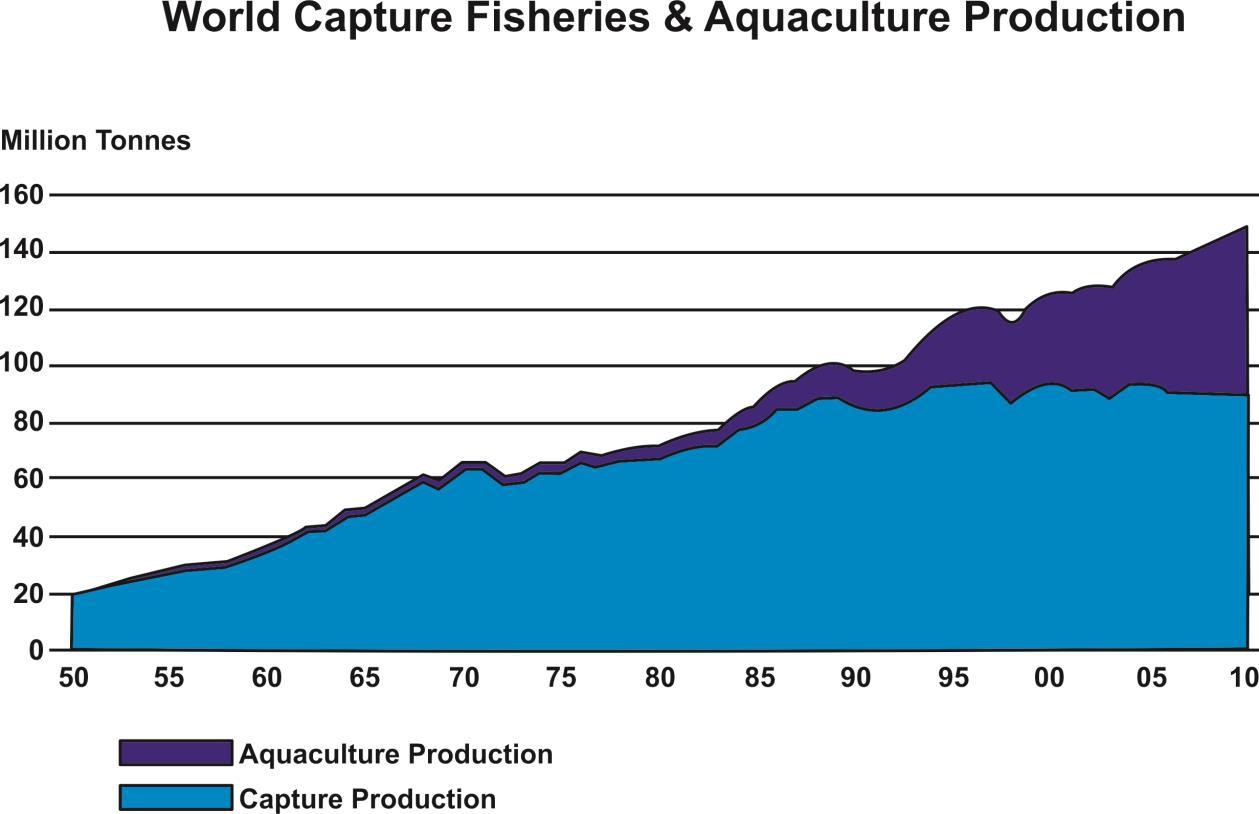
The graph indicates the growing need for aquaculture as the answer to sustain the global demand for fish and fish products. According to the FAO a large amount of fish consumed in developed countries consists of imports due to continued demand and local production declining, their dependence on imports from developing countries from Africa and the East is projected to increase.
THE FAILURE OF THE ‘GREEN REVOLUTION’ IN AFRICA
The ‘Green Revolution’ was brought about mainly by the plant breeders with the introduction of improved crop varieties such as Mexican Wheat, and these new varieties enabled many of the under-developed countries to increase their agricultural production. Countries in Asia benefitted from new rice and wheat cultivars and increased use of irrigation, fertiliser and pesticides. Africa did not see the results of the ‘Green Revolution’ due to other issues such as lack of infrastructure, access to land, and agricultural credit and training. However there has been significant interest being shown to African agriculture since the early 1990’s as countries have become settled and governments, NGO’s, companies and investors realise the huge un-tapped potential of African agriculture. Africa is ripe for its own green revolution which will not only incorporate modern agricultural technology like seed and fertiliser but conservation practices like no-till land preparation and integrated pest management.
As countries develop, people tend to leave the rural areas and move into the towns and cities, which is known as urbanisation. People who move to the cities and towns do not have the land to produce their own food and therefore have to work to afford food. This food can come from only two sources; surplus food produced by the farmers who are left on the land or by importing food from other countries.
The task of the farmer in any country is to produce enough food to feed not only himself and his/her family but also to have a surplus which he can sell at a profit, using the money to improve both his/her farm and lifestyle. The idea of making a profit is a highly motivating factor in any business, and farming is no exception. In the modern world, farming should be regarded as a business where the farmer must make a profit or lose his farm. Once this characteristic has been developed then the best farmers will succeed and land will be utilised efficiently and conserved for the farmer’s future and his family’s future production on the land. In America only 2% of the population are farmers, in Britain 4% and in Europe 5%. The remaining population are involved in other sectors of the economy. The average American commercial farmer currently feeds 155 people compared to just 26 people in 1960. American farmers also produce about 40% of the world’s maize and they export more than $100 billion worth of crops and products all over the world. These are highly developed primary agricultural sectors with large processing industries; good farmers which are backed up by extension services and sound research. To be able to feed the world population in 2050, this type of efficient and highly productive primary agriculture sector is needed.
Farm Management is concerned with the financial side of the farm; the study of farm planning, budgeting and marketing, so that the farmer can operate his farm business at a profit. It is a very important part of agriculture for the practical farmer, however small or large his enterprise.
2. DETERMINATION OF PRICE
Goods command a price firstly because they are useful and people want them, and secondly because they are in short supply in relation to the people wanting them. Air and water are wanted by people, but because they are freely available they don’t have to be bought. Goods are divided into commodities, like tobacco, maize, fertilizer etc., and services, like work, transport, insurance etc.
The price of any goods depends on:
- Their usefulness, necessity or popularity as expressed by the Demand of the people who want to buy them.
- Their scarcity as expressed by the Supply of the people who sell them.
Therefore the Price of goods is determined by Supply and Demand. However, this is constantly changing because:
- People’s requirements change as their living standards change either up or down.
- Technology and manufacturing methods change making goods easier to produce.
- Supplies of natural resources change, i.e. – land, coal, oil supplies etc.
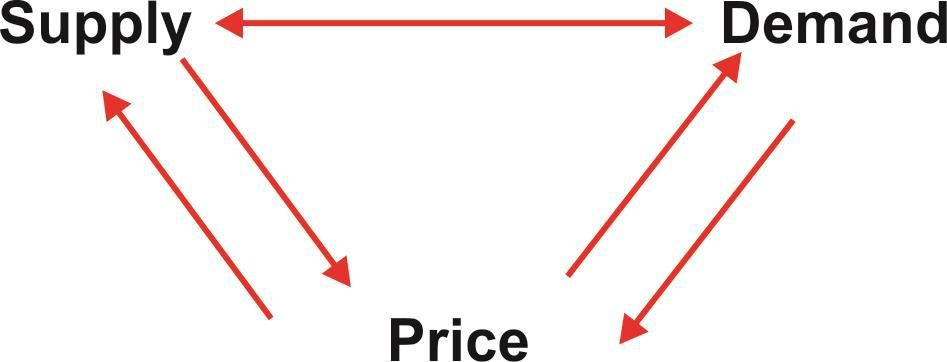
Supply, demand and price are all connected and any alteration of one will affect the other two, for instance; a tax put on tobacco will push up the price, which in turn will lower demand and so affect the supply.
Government Control of Prices and the Free Market System
Governments cannot set a price on farm goods because the only control they have is the extent of sales inside the country. Once goods are imported or exported, their price is controlled by the world markets, and South African agricultural production is too small to influence world prices. Once Governments try to alter prices, the result is an imbalance between Supply and Demand and often a fall in National Income. Therefore the market forces such as Supply and Demand create the prices in the market. This is evident in agricultural markets. When a crop like maize is harvested and there is a large amount for sale the price is low and then in the growing periods the price rises again because demand is constant but there is no supply. The free market system is when the market forces of Supply and Demand set prices.
3. LAWS OF SUPPLY AND DEMAND
DEMAND
Before going any further it will be best to define the term Market. A Market is any organisation or place where buyers and sellers meet or keep in close contact with each other. It can be a building, such as Durban Fruit and Vegetable Market, or Smithfield Meat Market in London, the Maputo street market or the Johannesburg Stock Exchange. It can be a collection of cattle pens like any of the cattle auction markets, or it can be a telephone taking the place of personal contact. It can also be websites on the internet and most of the developed world use the internet as a market place, whether it be to trade shares, buy clothes and food, the internet has become the modern market place.
In any market, the amount of goods demanded by the customer will depend on the price of the goods. The following table gives, as an example, the amount of wheat bought by millers at different price levels. The wheat will be ground by the millers at different price levels. The wheat will be ground by the millers and then sold to the bakers to make bread or processed into cattle feed.
| Wheat Price $ per Bag | Quantity Bought by the Millers |
| 12 | 5 000 tons per month |
| 10 | 7 000 tons per month |
| 8 | 9 000 tons per month |
| 6 | 11 000 tons per month |
| 4 | 15 000 tons per month |
| 2 | 20 000 tons per month |
If these figures are plotted onto a graph, it looks like the following:
Figure 4: The Demand Curve
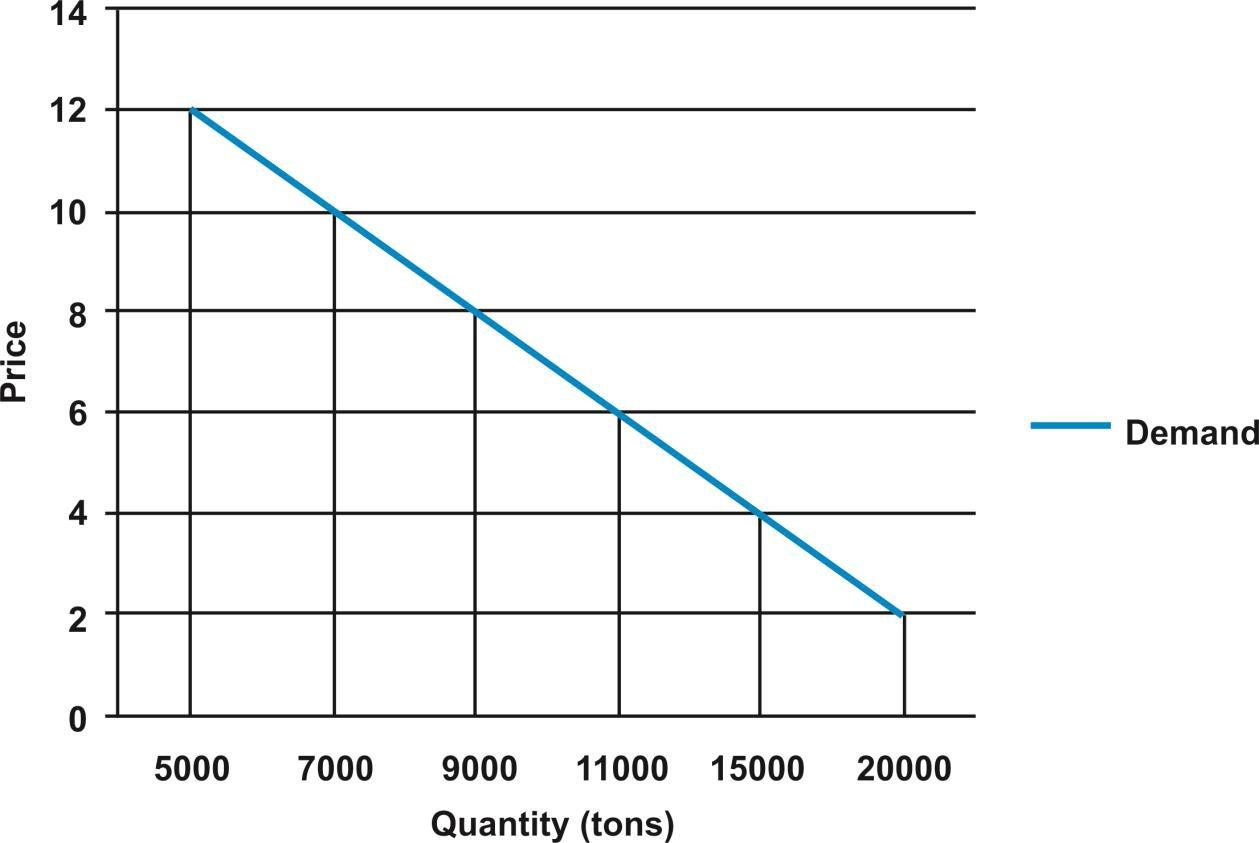
This is called a Demand Curve, and it runs downwards from left to right. This is because price and quantity demanded are inversely related. The higher the price, the less the demand for a commodity, and the lower the price, the higher the demand.
There are two main reasons for this:
- Substitution: when wheat prices are high, the millers will buy less wheat and instead will buy maize at a lower price.
- Income: when people’s incomes are low, they have less money to spend and they buy fewer of the highly priced commodities. As incomes rise, so they buy more.
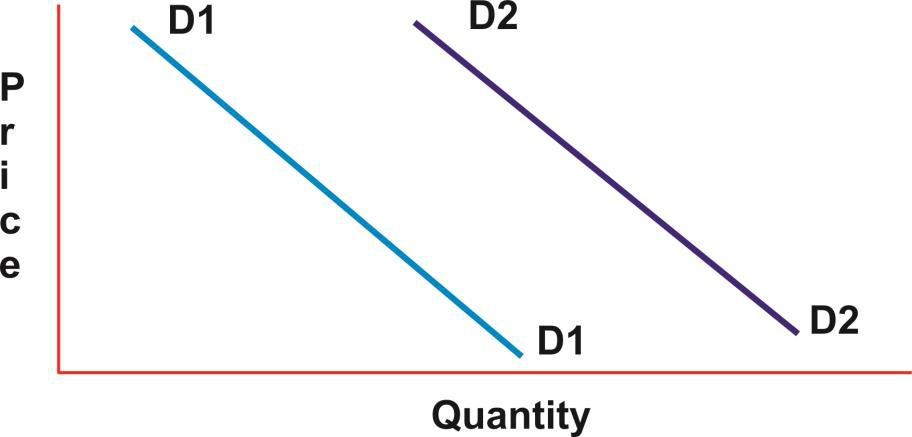
Where a general rise in living standards takes place, more wheat will be demanded at every price level and the whole demand curve will move to the right, as can be seen from the graph below.
Figure 5: The shift in the Demand Curve
SUPPLY
In the market, the amount of goods supplied by the sellers will depend on the price of the goods. The following table shows the amounts of wheat supplied to the market at different price levels.
| Wheat Price $ per Bag | Quantity Bought by the Millers |
| 12 | 18 000 tons per month |
| 10 | 17 000 tons per month |
| 8 | 16 000 tons per month |
| 6 | 14 000 tons per month |
| 4 | 12 000 tons per month |
| 2 | 6 000 tons per month |
If these figures are plotted onto a graph (see overleaf), the result is called a Supply Curve, and you can see that it goes upwards from left to right. This is because price and supply are positively correlated; the higher the price, the more the supply to the market. A general increase in prices will shift the whole curve over to the right, as can be seen from the second graph.
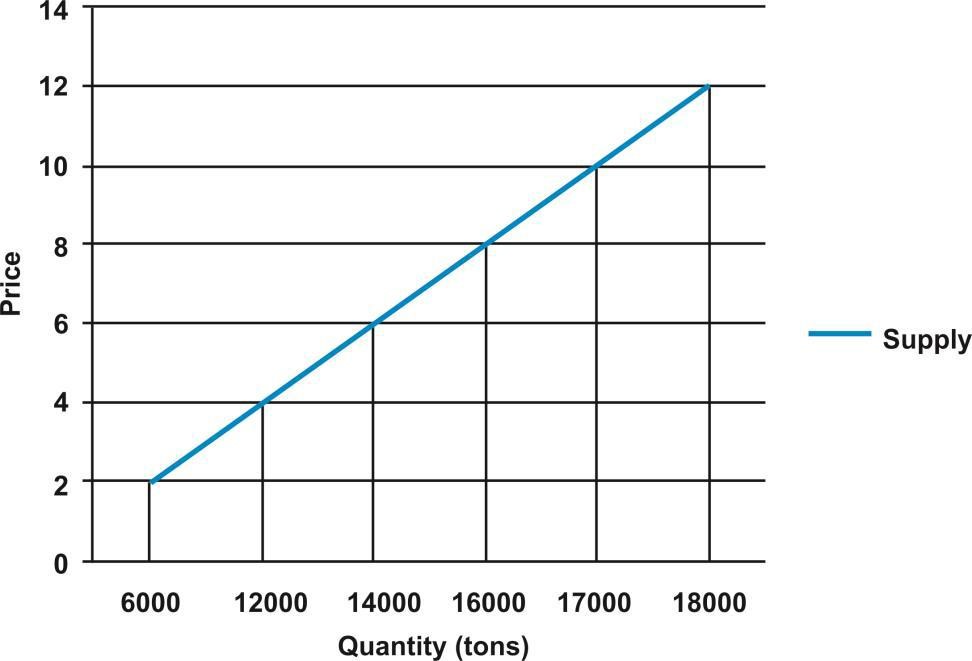
Figure 6: A Normal Supply Curve
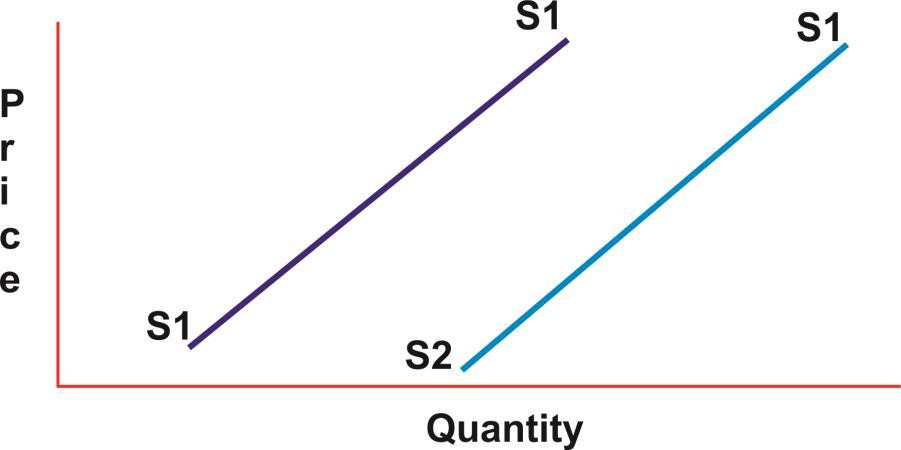
Figure 7: Supply Curve Showing a General Increase in Prices