
The Honey Bee Colony
1. INTRODUCTION
Keeping bees can be a profitable and interesting occupation. There are many kinds of bees; solitary bees, stingless bees, bumble bees, etc., but the only bees which can be profitably kept are the social bees, Apis mellifera, which are very prolific. They are slightly smaller than their European counterparts, their strains differ in size, colour, temperament and behaviour, and they do have the reputation of being aggressive. Bees live as a family which is called a colony or a swarm and their home is called a hive. The colony is headed by one, perfect, fully developed female, the queen, and, it comprises a few hundred males, called the drones. There are also several thousand under-developedfemales calledthe workers, which perform all the work, both in and out of the hive.
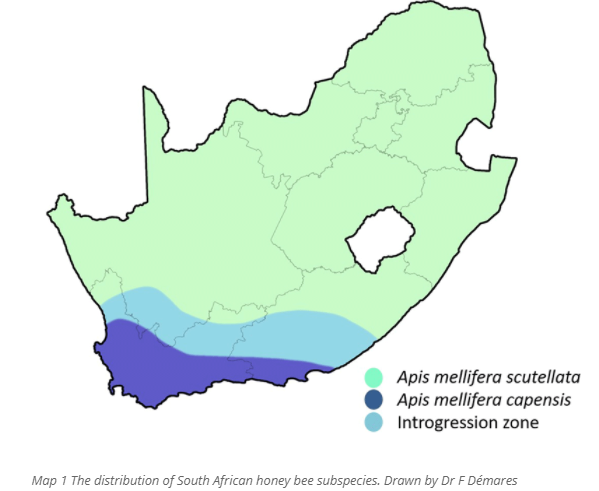
There are 2 types of honey bees in Southern Africa – see the map below.
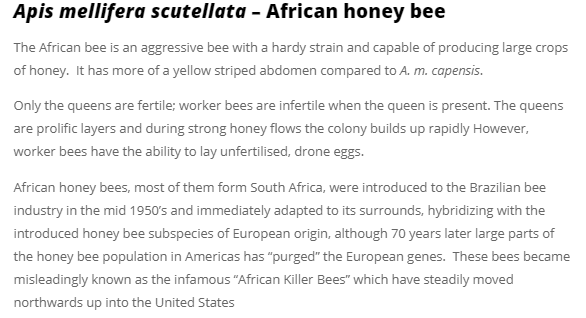
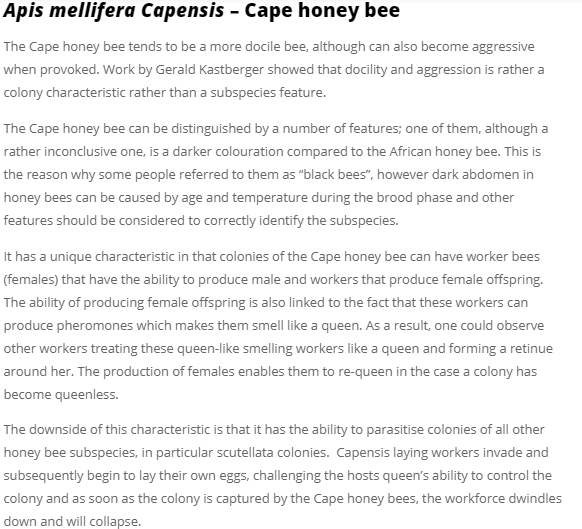
See what the South African Bee Industry Association says about these species:
2. THE HONEY BEE COLONY
The bee strain in Central Southern Africa is not very stable as a swarm. It is unpredictable and it is never possible to be absolutely sure what a swarm will do next; nor can one judge by the behaviourof one colony what its neighbour will do. Each swarm has its own personality. The queen is a fully–developed bee 20 – 22mm long. She possesses a curved smooth sting which she uses only against other queens. The queen can live as long as 5-6 years, but she is not really any good after the second year, and must be replaced by the bee-keeper if the bees have not already done so.
The queen’s only function in the hive is to lay eggs in cells, which are well prepared and cleaned by the worker bees. Although she is the centre and heart of the colony, she has no control over her offspring. The worker bees feed her with special food, the quantity and quality of which controls the number of eggs she lays. She can lay up to 3000 eggs daily. The queen must be fed, groomed and cleaned by the worker bees. When doing this they touch her with their antennae and lick her, thus getting from her one of the hormones she produces, a substance called pheromone. The bees pass this on to the other bees in the hive, thus assuring them that the queen is present and so keeping them happy and active. This substance diminishes as the queen becomes older and when this happens and the bees do not get enough of it, they become restless and will probably replace her. Also, if the hive becomes overcrowded, the substance is not enough to satisfy all the bees and preparation for swarming starts.
A queen is hatched from a fertile egg in a special and private cell which hangs upside down and is much larger than all the other cells. Three days after the egg is laid, it hatches into a small larva which the worker bees feed with abundant food produced by glands located in their heads. This food is called royal jelly. The larva is fed for 5 days by which time it is fully grown and fills the cell, the bees then seal the cell with a porous cap; the larva spins a cocoon, has a few days rest and finally emerges as a fully developed female. The whole development from egg to maturity takes 15 or 16 days, depending on the race of the bees and the temperature.
Within a few days, the queen is sexually mature and flies out of the hive on her nuptial flight. She mates with 4 or more drones and stores the sperm in her spermatheca. Mating takes place on the wing several metres above the ground. The queen then returns to her hive and, after resting for 2 – 4 days, she starts oviposition. She does not leave the hive again except with a swarm. She lays fertilized and unfertilized eggs. Both kinds hatch into larvae, but a larva from an unfertilized egg grows into a drone and a larva from a fertilized egg grows into a worker, or a queen if the larva is fed by the workers on the special substance called royal jelly.
DRONES
A drone is a male bee hatched from an unfertilized egg. He is larger than a worker and fatter than a queen. He does not possess a sting. He does not work and his contribution is to fertilize the young queens. After mating the drone dies. When food is short, and no more is brought into the hive, the workers stop feeding the drones and throw them out of the hive to die. Since the drones have neither a proboscis nor pollen baskets, they cannot collect either nectar or pollen.
WORKERS
A worker bee is an underdeveloped female. It cannot be matedand although it can lay eggs under certain conditions, its eggs are unfertilized; consequently only drones can hatch from these.
A worker is raised in a small hexagonal cell and requires 20 – 21 days to emerge as a fully grown insect. The porous cap of the cell when sealed is practically flat and differs greatly from the drones cell cap. Both kinds of cells, the workers and the drones are used repeatedly, and when a brood is not reared in them the bees fill them up with honey or use them to store their pollen. The queen cell is destroyed by the bees after the queen emerges and is never used twice.
The worker has a straight barbed sting which it uses to defend its queen, family and food. It dies after stinging.
Its hind legs are longer than the other two pairs and possess strong curved hairs which form containers, the pollen baskets, in which it packs pollen to carry back into the hive. The worker also possesses inside its abdomen, a special sac called the honey sac which carries the nectar. It has eight glands on the underside of its abdomen and a scent gland which is located at the end and on the top of its abdomen.
| Propolis: a red or brown resinous substance collected by honeybees from tree buds, used by them to fill crevices. |
The workers do all the work in and outside of the hive, and become active a few hours after emerging from the cell. For the first two or three weeks they do home cleaning, nursing duties, feeding the queen and larvae, build combs and guard the entrance of the hive against all sorts of intruders.
Once a day, usually during the hottest time of the day, the young worker leaves the hive to make recognition flights, short at first, but increasing in length as its wings become strong enough to undertake field duties. Then it collects pollen, nectar, water and propolis. It works itself to death.
At the peak of the honey flow, the life of a bee is about six weeks.
Social bees cannot live individually. They live as a complete and balanced unit and if that balance breaks by accident or bad management on the bee-keepers part, the colony will eventually die out.
A working swarm appears to be chaotic, but this is not so. Every bee, according to its age, has its own duties and activities and does not interfere with its fellows.
Figure 1 and 2: Left: Queen Bee and Right: A Queen Bee surrounded by Worker Bees
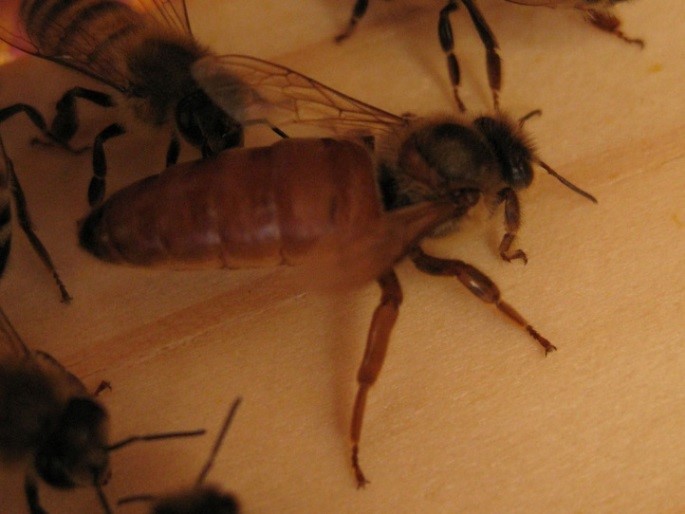
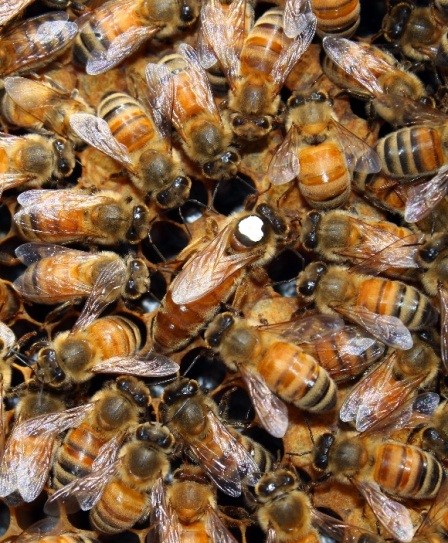
Source: thebeeyard Source: beeinformed
POLLEN
The pollen provides the protein needed by bees for their nutrition and is stored in cells. It is mixed with honeyto produce the bee-bread which is fed to the larvae and adult bees. A strong colony needs about 20 – 30kg of pollen each year.
NECTAR
Nectar is the sweet liquid secreted by flowers, collected by means of the bees’ long proboscis and it is stored in its honey sac until transported to the hive and deposited in the cells. Nectar in a honey sac undergoes certain changes during the flight home, thus starting the transformation into honey. The final ripening is performed in the hive by house bees which evaporate excess water from the nectar.
Water, is very necessary for the swarm and is used by the nurse bee to dilute honey, which she kneads with pollen to make food for the larvae. In hot weather the bees spread water on the combs which they .then fan to evaporate, thus cooling their home. Water is not stored in the combs; the bees collect it only when it is needed.
PROPOLIS
Propolis is collected from certain trees such as pines, firs, poplars etc. It is a sticky resinous substance which bees use to reduce the size of the entrance to their home, to fill cracks and to stick frames together. It also serves to embalm enemies which have been killed after entering the hive but which are too heavy for the bees to carry out.
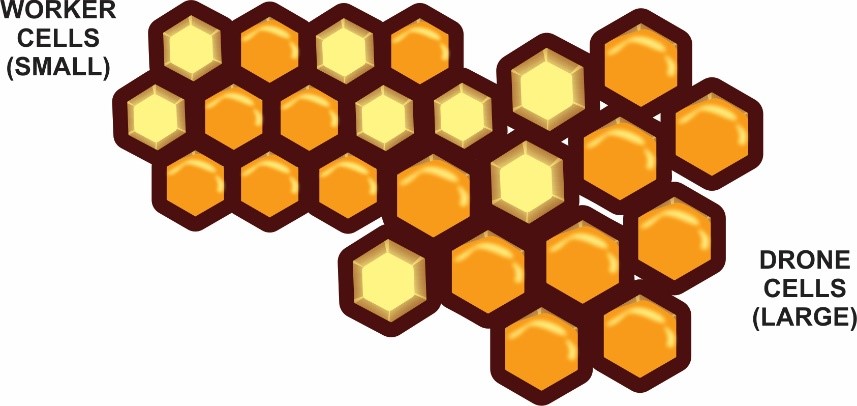
Figure 3: Shows Small Worker Cells and Larger Drone Cells
QUEEN BEES
The queen bees are reared in specially constructed, larger cells because they grow bigger than the worker bees. They emerge from their cells about 15 days after the eggs have been laid.
Queen cells are used only once, unlike the worker and drone (male bee cells) which are used many times. Queen bees can live for many years while the worker bees have a lifespanof about seven weeks.
The life of the worker bee is very short, therefore the queen has to lay a great many eggs so that the worker force is constantly being replaced and kept up to strength. Younger queens, those that are 18 months to 2 years old, lay single eggs in each cell in the comb. The queen can lay 3000 eggs a day, but she can do this only if she is very well fed by the worker bees in the colony. At this rate, she is laying her own weight of eggs in one day. These eggs take3 days to hatch into small larvae and these are fed for nearly 3 weeks during which time they grow very rapidly.
Experienced bee keepers know that good young queens are much more productive and profitable to keep in their hives than old queens that will lay fewer eggs. Some bee keepers breed their own queens to replace old stock, and queens can sometimes be obtained through local bee keepers associations.
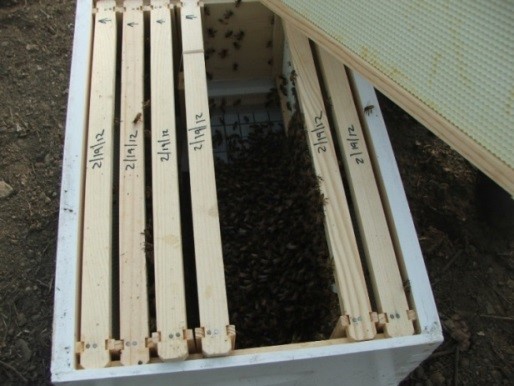
Figure 4: A Man Made Bee Hive
(Source: A Guide for Beginner Bee Keepers, Ms P. Papadopoulo) (upload.wikimedia)