The Vegetable Garden
This module covers general horticulture and is intended for both amateur gardeners and professional growers, whether they are market gardeners or farmers who wish to include vegetables in their cropping plan.
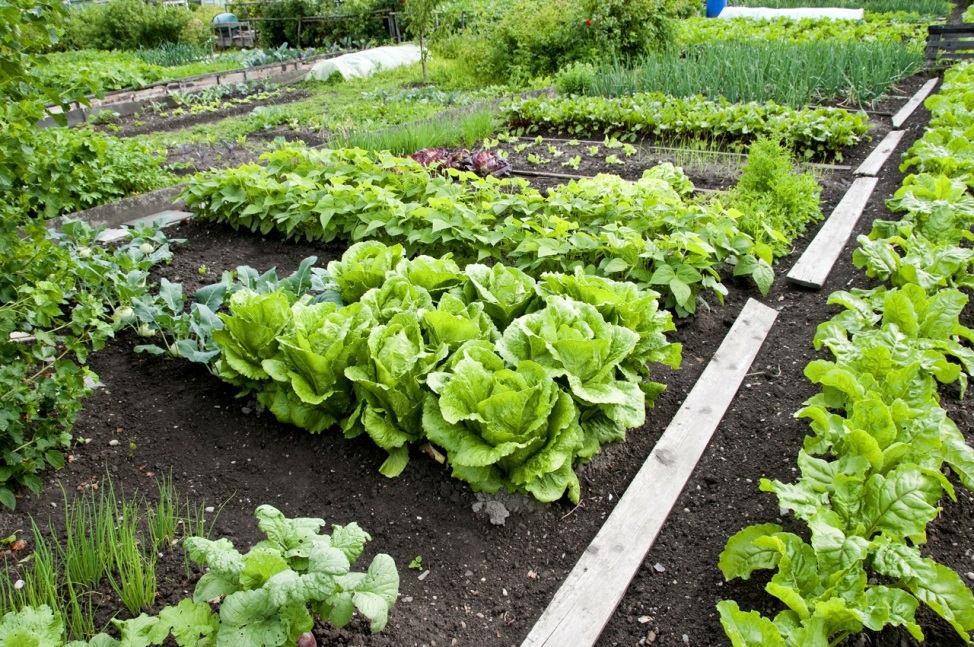
Figure 1: A typical vegetable garden
1. LAYOUT OF THE VEGETABLE GARDEN
Before starting to produce fruit and vegetables, either for home consumption or for sale, the area of the garden should be carefully planned in order to achieve the best results. The basic principles which are important in horticulture are as follows:
There must be a good reliable source of water either from a dam, borehole or water main. The majority of vegetable crops grow best during the winter dry period from March to October. During the hot dry period in October and early November before the rains have started, the supply of water must be sufficient to provide full irrigation during the time when the crops require the most water. Furthermore, the source of water must be reliable enough to last throughout the 7 – 8 dry months. Have the water supply tested for soluble salts before starting to grow irrigated vegetables. Some water, particularly from boreholes can have a high content of salts which can damage the soil and produce poor growth.
Test for the texture and nutrient content of the soil, by sending soil samples in for analysis to the nearest testing laboratory. Most crops prefer a sandy loam soil and if a choice is available this type of soil should be chosen. Although lighter soils have poorer water and nutrient holding capacity, they are easier to work and drain better. Soils which form a crust or cap on drying out should be avoided as they can prevent the even germination of seedlings. The acidity or alkalinity (or pH) of the soil should be determined by analysis.
For the purposes of planning a workable crop rotation, vegetables may be arranged into four main groups:
Group 1: Cabbage, cauliflower, broccoli, Brussels sprouts (all brassicas), onions and celery.
Group 2: Carrots, beetroot, parsnips, turnips (all root crops), kohlrabi and sweet potatoes.
Group 3: Tomatoes, potatoes, peppers, eggplant (all solanaceous), lettuce and Swiss chard.
Group 4: Green beans, Lima beans, broad beans and peas (all legumes).
The cucurbit family (cucumber, pumpkin, squashes, marrows and melons) can be included in any part of the rotation as they are not generally affected by specific soil-borne diseases. The same applies to okra, sweetcorn, radish and endives.
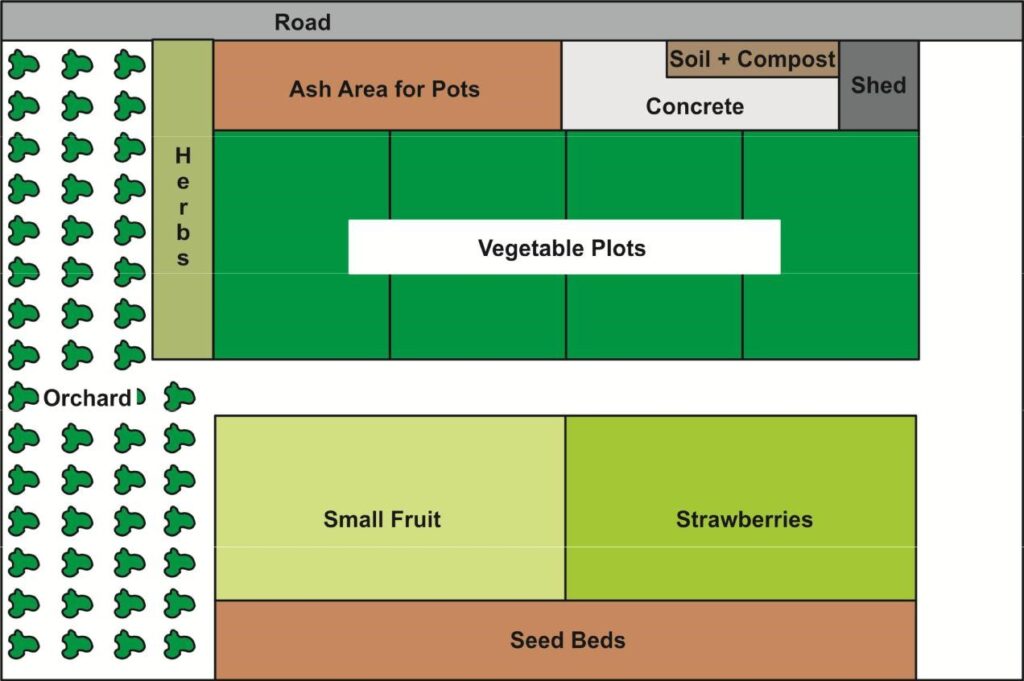
At least 4 large plots should be laid out for vegetables with a path between each plot. The plots should be roughly the same size and are used to plan and control the cropping rotation. Rotation is an important aspect of horticulture and is necessary in order to avoid certain pests and plant diseases building up in the soil. Cropping a plot continuously with a single crop can lead to a destructive buildup of pests and diseases. With 4 plots, the following rotation can be operated:
Table 1: Planting Program for a Market Garden
| Plot A | Plot B | Plot C | Plot D | |||
| Year 1 | Group 1 | Group 2 | Group 3 | Group 4 | ||
| Year 2 | Group 4 | Group 1 | Group 2 | Group 3 | ||
| Year 3 | Group 3 | Group 4 | Group 1 | Group 2 | ||
| Year 4 | Group 2 | Group 3 | Group 4 | Group 1 | ||
If this plan or if a similar rotation is followed, any single crop is grown on the same plot only once every 4 years. This is to prevent the buildup of such organisms as eelworms which attack potatoes and tomatoes, and other pests, which attack the roots of the brassica crops. Often salad crops, which follow a crop like potatoes which have been heavily fertilized, can be grown with very little additional fertilizer as the residues from the previous crop are used. Organic manure can be applied once in the rotation e.g. to the potato and tomato crop so that the whole area of the garden is manured every 4 years. Generally, a good rotation carried out properly, allows for sound planning and good management. Disease and pest carry-over can be countered by careful attention to rotation planning.
An area should be set aside for seedbeds which are used to raise seedlings for transplanting into the large plots. Although some crops are better sown directly into the land and then thinned out, most vegetable crops can be raised in seedbeds and transplanted when they are large enough to handle. This is good practice as less seed is used and good strong plants can be selected for transplanting. The seedbed area should be used in a rotation so that the same seeds are not sown on the same piece of ground each year.
If desired, an area can also be set aside to use as a permanent orchard for fruit trees. The choice of trees planted will depend on the area, soil type, climate and the requirements of the individual gardener.
An area should be used to grow strawberries, which are a perennial crop but are renewed every 2 or 3 years, by planting runners in fresh ground to make new beds. Strawberries are susceptible to eelworm and should be planted in ground that has not grown the crop for at least 3 years. A permanent area for a crop of strawberries allows the grower to build a frame so that netting can be spread over the plants during the fruiting period to prevent damage from birds. Fallow ground in the strawberry area can be used to produce salad crops.
The potting area should have a hard, preferably concrete, surface for mixing potting
material, and bins or covered brick partitions for storing the different materials needed to make up potting compost. Potting compost consists of sand, sieved soil, leaf mould or compost and straight or compound fertilizers. Next to the concrete should be an area slightly raised above ground level for placing the potted plants. The base of this area should be ash, or some other free draining material, so that the pots do not become waterlogged. The area should be provided with shade.
The final requirement is a good shed to store garden tools, pots, canes, lines and the herbicides and insecticides required. The shed should have a good lock, as many of the chemicals used in horticulture are hazardous, particularly to children. The garden tools should have their own place in the shed and be cleaned before being put away. Watering cans and sprayers that have been used for spraying chemicals should always be washed and flushed out at least three times before being put away. This is very important in the case of herbicides.
A general plan for a vegetable and fruit garden is shown on the next page. The area of the plan is intended to be 1 acre (0.4 hectares), but can be adapted to any size by simply altering the actual size of the beds.
Figure 2: A Plan for a Market Garden