
Lecture 1 – Breeds of Poultry
1. INTRODUCTION
The domestic hen appears to be descended from Gallus bankiva, a species of wild fowl found in parts of Asia, particularly Burma, India and Sumatra. By the beginning of the Christian era (e.g. 2000 years ago) the birds had probably reached Europe. Their domestication and spread was due partly to their value as food producers and also very largely because of the sport of cock fighting. Fowls have proved to be particularly adaptable and have been moulded into a number of breeds and varieties, each possessing special characteristics.
| Moult: shed old feathers to make way for new growth. |
The wild jungle fowl breeds only once a year, lays a clutch of eggs which the hen broods and incubates and she looks after the young chicks after they have hatched. The young reach sexual maturity at a year old, and adults moult once or more times a year.
Breeds used in modern poultry farming have been selected so that the short natural laying period has been extended to a period of about ten months, and the natural clutch of 12 eggs has been increased to well over 200. Adult birds seldom go broody, which means that they will not sit on eggs to incubate them. Young birds reach sexual maturity and commence laying at 20 – 24 weeks of age. Although the laying powers of fowls have been developed to a remarkable degree, production does not continue indefinitely and birds will stop laying and go into a moult. Once moulting is over, the birds will start to lay again, but production during this second season will be about 20% below the production of the first season, although the eggs that are laid will be larger. Healthy hens will continue to lay for many seasons, but the normal practice with commercial poultry is to keep the birds for one season’s lay and then sell them for meat, replacing them with point-of-lay pullets. Depending on the size of the poultry unit and the available housing, a supply of eggs can be maintained throughout the year by replacing the various flocks at different times during the year. In Africa, egg production is highest during spring and Summer which is the period of lengthening daylight, and in order to achieve the best production in winter, birds that are housed should be provided with artificial light. The egg production of birds kept on free range will follow the natural pattern of the seasons.
POULTRY TERMS:
Poultry are economic converters of home grown and purchased foods into both eggs and meat, poultry manure is a very valuable source of plant nutrients, and can be fed also to both cattle and sheep as a protein supplement.
DAY OLD CHICK:
A young chicken immediately after hatching.
FEATHERING:
The period during which the down of the young chick is replaced by feathers.
This happens at about 4 weeks old.
PULLET:
A young hen from the time it is fully feathered to the time when it completes its first laying season.
POINT OF LAY PULLET:
A young hen at 20 weeks old just about to come into lay.
INCUBATION:
The period during which the embryo is growing inside the egg, prior to hatching.
BROODING:
The period during which the newly hatched chicks require, to be kept warm.
BROODY:
The condition of a mature hen when she will sit on a nest of eggs in order to incubate them.
MOULT:
The period when a mature hen stops laying, and her feathers fall out to be replaced by a new growth.
BROILER:
A chicken reared to provide meat and killed at 6 – 10 weeks old.
COMB/WATTLE:
Growths on the head of a cock or hen which are used as signs of a pullet coming into lay, and of poor health in a bird.
2. PURE BREEDS
The breeds of poultry are so numerous that they cannot be considered in detail. They can be grouped into those breeds that have been developed mainly for egg production, those that have been selected for meat production and dual purpose varieties that are suitable for both purposes.
These days most commercial poultry producers use hybrid stock bred for either egg or meat production, and the main purpose of pure breeds is to provide the foundation stock for the breeding of hybrids. Some of the more important pure breeds with their characteristics are as follows:
EGG-LAYING BREEDS:
- These are heavy layers of white eggs;
- They seldom go broody;
- They are light in weight, lean and not very heavily feathered;
- They are active, nervous and become very excited when disturbed;
- They have a good food conversion ratio. Being small, they eat less food than the larger breeds but produce more eggs.
Members of the Breed are:
- White Leghorn
- These are an Italian variety which spread to America and back to the U.K.
- A typical cock weighs about 2,7kg and a hen 2kg.
- Brown Leghorn
- Black Leghorn
- Ancona
- Andalusian
- Minorca
TABLE OR MEAT BREEDS:
- These are heavy fleshing birds.
- Breeds show considerable variation in size, egg-laying capacity, colour of flesh, colour of eggs, etc. Birds with white flesh and white legs are preferred for the table to those with yellow flesh.
Members of the Breed are:
- Light Sussex
- An English variety with white feathers speckled with black markings. They combine good meat quality with very good egg production. Cocks weigh 4kg and hens 3kg
- Faverolle
- Dorking
- Indian Game.
DUAL PURPOSE BREEDS:
- These produce good carcasses and nearly as many eggs as the light breeds;
- They are placid birds, well-feathered and hardy;
- When kept in deep litter houses or battery cages, they tend to become too fat and are prone to broodiness, and this reduces their egg yield;
- They nearly all lay brown or tinted eggs.
Members of the breed are:
- Rhode Island Red
- They have copper coloured feathers. Cocks weigh 3,7kg and hens 2,7kg, and the hens lay brown eggs.
- New Hampshire Red
- White Wyandotte
- Orpington
- Plymouth Rock
3. CROSS BREEDING
Cross breeding is carried out with all farm stock, and poultry are no exception. In fact, the vast majority of commercial poultry stock in the developed countries are cross breeds, or hybrids. A hybrid is obtained by crossing two pure breeds and the result of this mating will be a crossbred, or hybrid, and this is called the F1 generation.
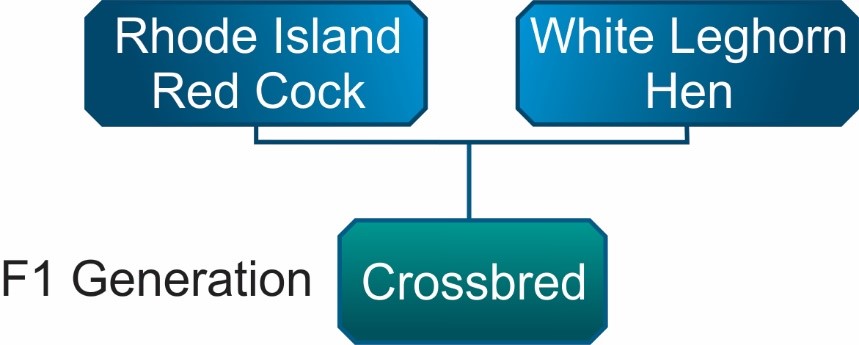
ADVANTAGES OF CROSSBREDS OR HYBRIDS
They can combine the best characteristics of both parents while leaving out the undesirable. In breeding for egg production, the ideal is to produce a bird with high egg production, low food intake, early maturing, with a good temperament and high resistance to disease. All these factors can be found in different pure breeds, and the breeder of hybrids tries to bring them together in one bird. The pure breed lines that are used as the parent stock are very carefully selected for the factors that the breeders require, so that the hybrid will have as many desirable characteristics as possible.
When animals of two different breeds are crossed, the offspring from the F1 generation will often perform better than either of the parents. This effect is created heterosis or hybrid vigour and is caused by the large number of fresh genetic combinations which have come into existence through the cross breeding. Hybrid vigour has the most effect on such factors as the number of eggs laid, food conversion and the general health, vigor and disease resistance of the birds.
The main disadvantage of hybrids is that the commercial producer cannot breed from his stock. Crossing two hybrids to produce a second or F2 generation will result in offspring that are worse than either of the parents, and the effect of the hybrid vigour is lost entirely.
In production of a poultry hybrid, usually more than one cross is used to breed the commercial hen.
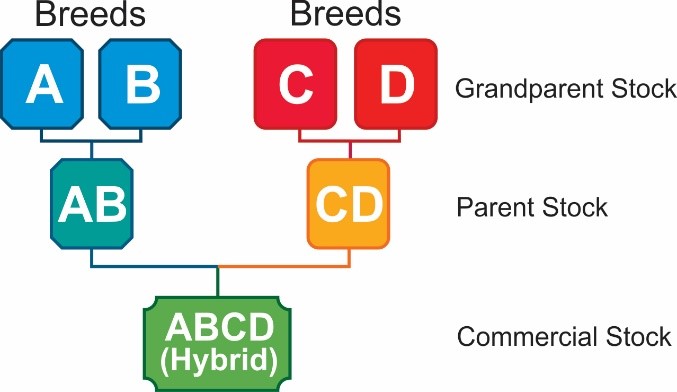
Hybrids for egg production are bred for size, colour and number of eggs per bird, together with low food intake and disease resistance. Hybrids for broiler production are bred for rapid growth and good food conversion together with good meat and carcass qualities.
SEX LINKAGE:
Laying hens are selected and bred to produce the maximum number of eggs with the least amount of food. The most economic layers are small birds that lay eggs rather than produce meat. It follows that the cockerels from such breeds or crosses are not worth rearing for meat and must be identified and killed off as soon as they have hatched. Large breeders who produce chicks for sale employ chicken sexers who can separate the cockerels and pullets at hatching. Otherwise the chickens have to be reared until the secondary sexual characters begin to develop. At this stage, 8 – 10 weeks old, the sexes can be separated by the size of the combs, wattles and tail feathers.
Sex linkage makes use of the fact that certain crosses between pure breeds will produce chickens that can be separated by sexes as soon as they have hatched. Examples of this are:
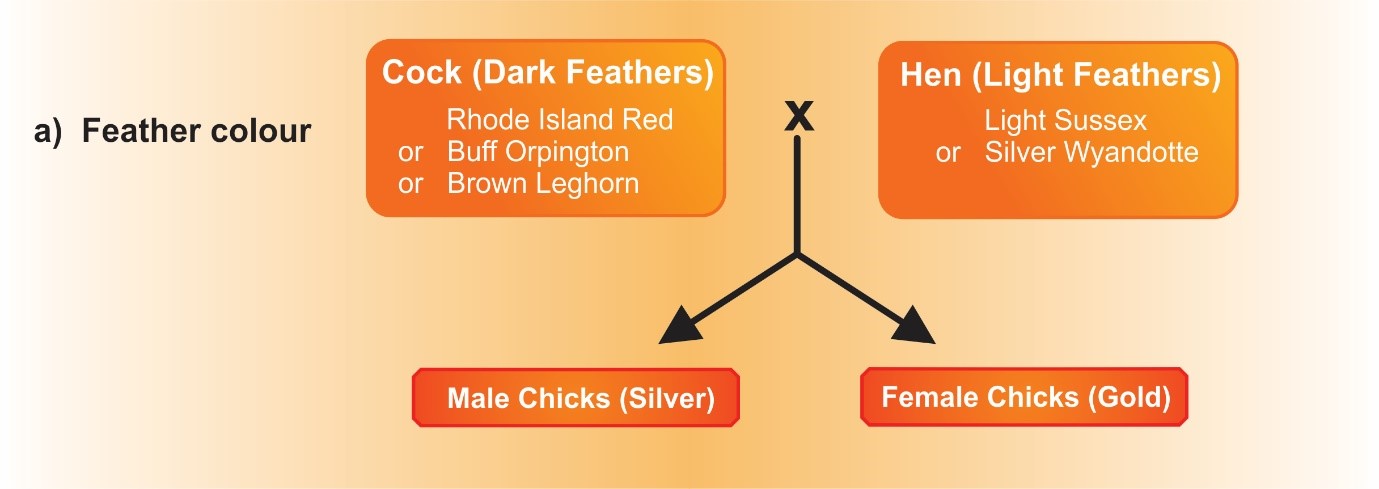
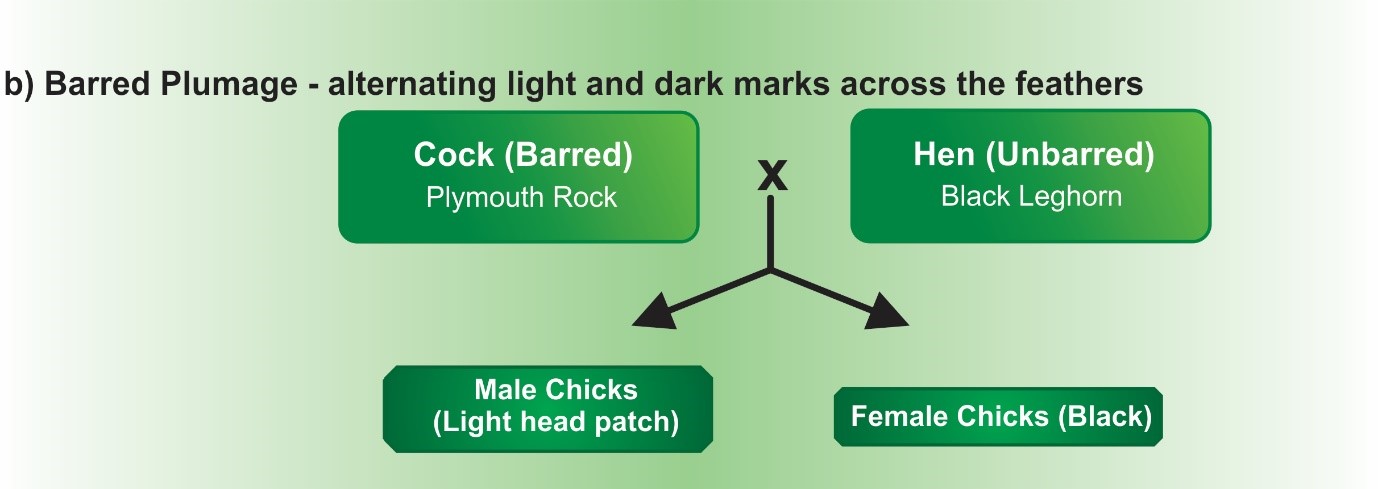
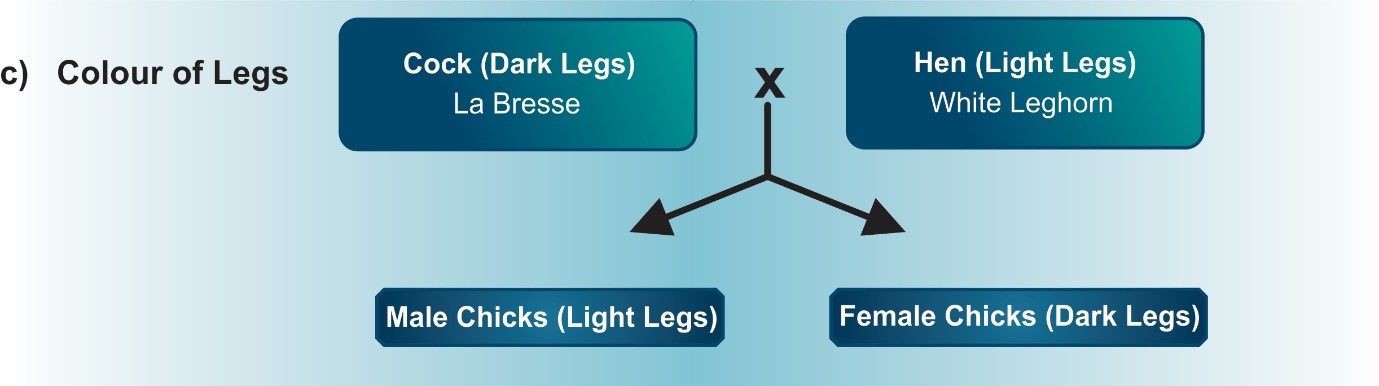
Sex linkage is a term used because the characteristics are linked to the sexes of the chickens. The dark plumage of the Rhode Island Red cock produces the gold colour of the female chicks, and the light plumage of the Light Sussex hen produces the silver male chicks.